
Bilona Ghee: Thirty Litres of Milk, One Kilo, Five Stages

By Prateek Singh · Pratapgarh Vedic Gau Gram
Thirty litres of cow’s milk go into one kilo of the ghee on this page. What happens to those thirty litres is the whole method, and it is done in five stages, by hand, in a kitchen you can walk into.
Bilona ghee is ghee made by churning set curd rather than separated cream. The curd goes into a wooden bilona, a hand-turned churn, the butter rises out of it, and that butter is simmered into ghee. Five stages, in this order, and each one decides something the next cannot fix.
Why does bilona ghee start with curd?
Ghee begins with a decision, and we take the older one. The whole milk is boiled, set overnight into dahi, and churned. Nothing is separated out first and nothing is added at any stage.
The curd is where the flavour starts. The butter that comes up out of it carries the tartness of the dahi it came from, and that is the first thing you meet when the lid comes off a jar: warm, nutty, and awake rather than flat.
A recipe can be copied in an afternoon. Where you begin is a decision you make once and then live with for thirty litres.
1. Boiling
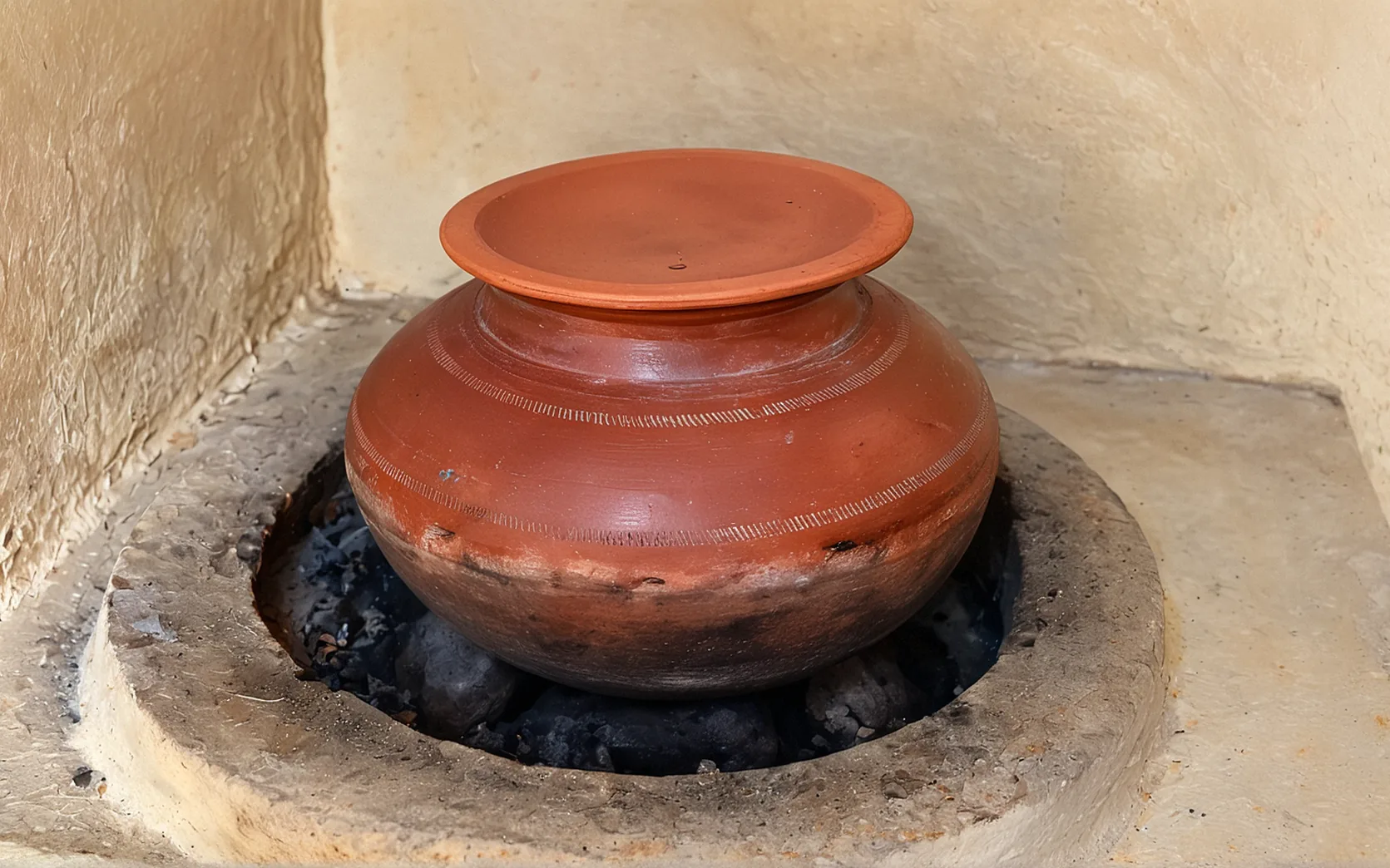
The milk comes up in a wide pan and is held there. Wide, because milk has to sit at a boil without climbing the sides.
A steady flame is what this stage asks for. Held at that heat the milk boils clean, the pan stays sweet, and the curd that comes next has something clean to work with.
Every litre after this inherits the pan it was boiled in. By the time the pan comes off the flame the day has a base to stand on.
2. Curdling
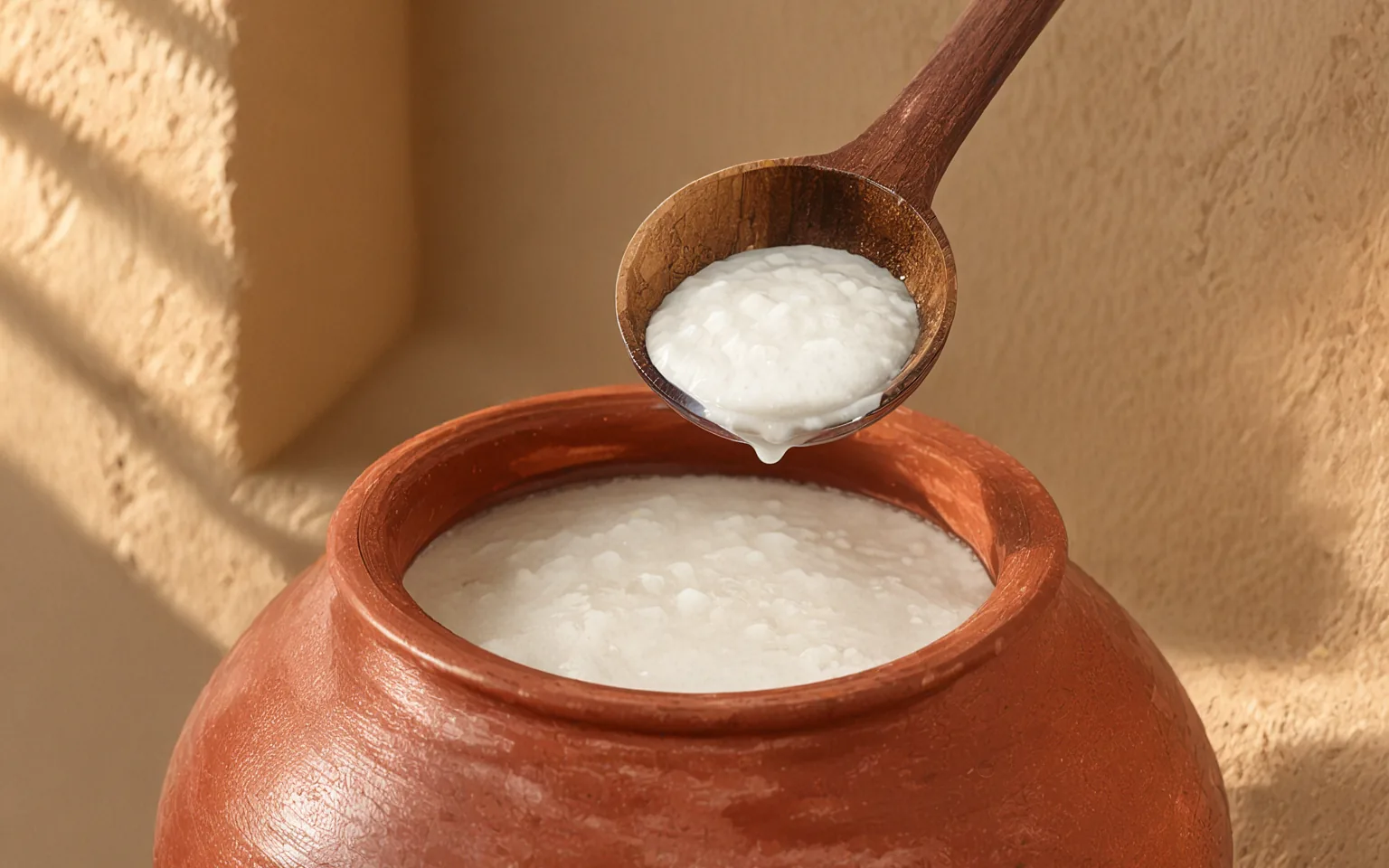
The milk is set into curd and left to take. This is the stage that decides whether the rest of the day works.
The curd is ready when it takes a clean break. A finger through it should leave an edge, not a smear, and that edge is what the churn needs to get hold of. Set like that, the curd lets its butter go in large soft grains and the churning becomes a short job.
Judged by hand and by eye, never by a clock. Set right, it has a clean, faintly sour aroma, and it hands over its butter without a fight.
3. Churning

The bilona is wood, turned by hand, standing in the curd. The butter rises when it is ready, and the churn tells you before the surface does: it goes from a slosh to a low thud, and that is the moment.
There is no gauge on this stage. The churn is the gauge, and the person turning it reads it by sound and by weight in the hands. That is the reason this stage has never been worth automating for us.
The work changes through the year. In summer the makkhan comes up quickly and stays soft in the warm room. In January the turning runs longer and the butter gathers firmer. The season sets the pace and the hand follows it.
Hear that thud and the worst of the work is behind you. What comes next is lifting the butter out of the churn.
4. Separating the makkhan
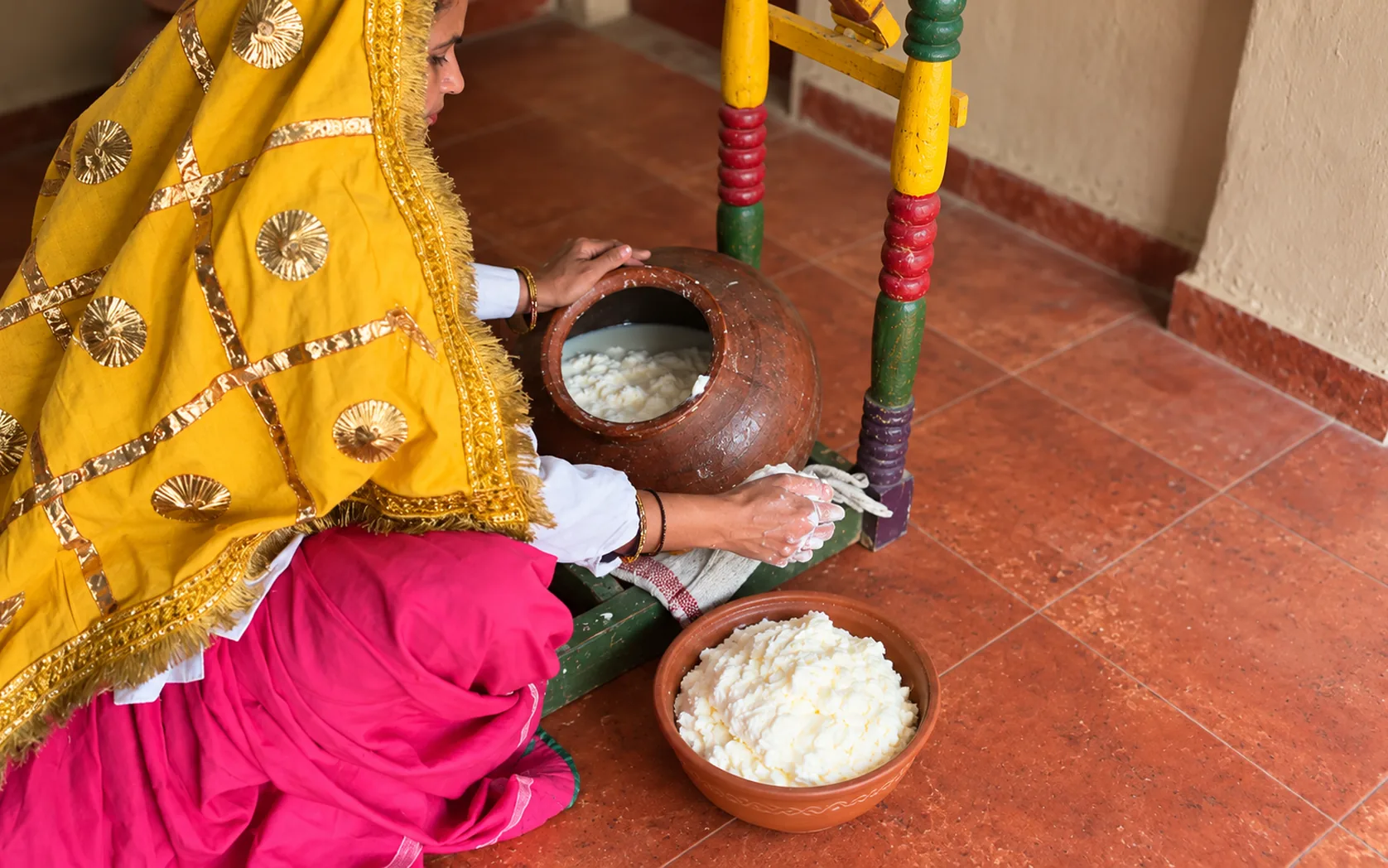
The butter is lifted out of the buttermilk by hand and gathered. This is makkhan, fresh butter, and it is the real starting material for ghee.
It is pressed just enough to hold together and no more. What the pan receives is butter and nothing else.
Makkhan at this point is soft and warm yellow, and its aroma is of the dahi it came from and of nothing yet to come. From here the day stops being dairy work and turns into something closer to confectionery.
5. Simmering
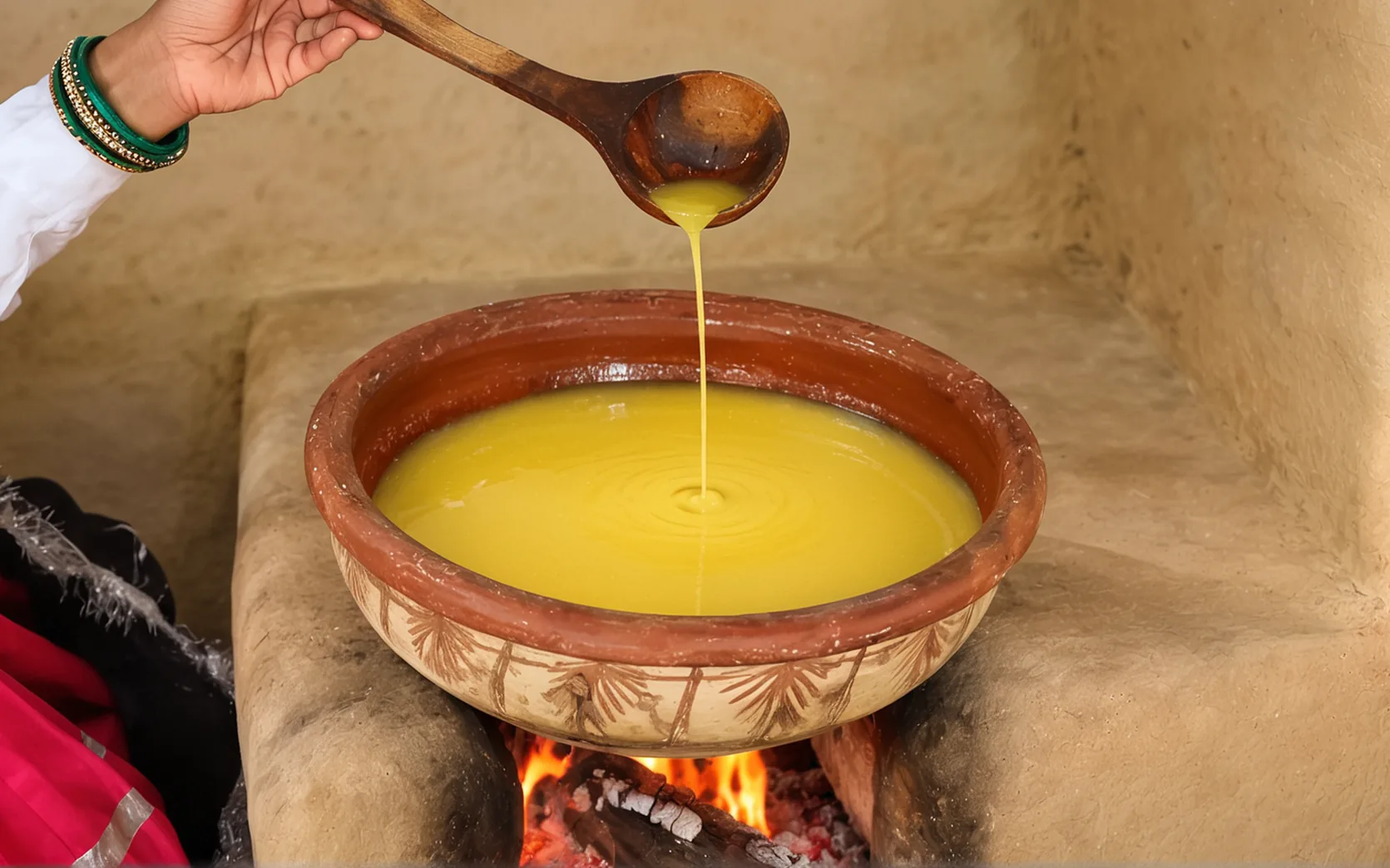
The makkhan goes into a pan over a slow flame. The water cooks away first, and you watch it go as the foam settles. Then the milk solids sink, take colour, and the kitchen fills with something closer to a sweet shop than a dairy.
A slow flame is what lets the water leave before the solids colour. Get that order right and the pan stays quiet, the foam drops away, and there is clear ghee underneath.
Then it is strained through cloth. What comes through is the whole morning, still warm, and it goes straight into the jar.
What comes out
Clear ghee, with the solids strained away and nothing left in the pan but the ghee itself. This is what ghee actually is, arrived at the long way round.
The colour belongs to the animal rather than to the method. Cow ghee comes out golden. Buffalo ghee comes out white and stays white when it melts. Both went through the same five stages, and the jar is the only place the difference shows.
Set in the jar it takes a grain. A spoon comes up through it in small pieces rather than in a smooth paste, and that grain is the most visible thing the method leaves behind.
A spoon of it on a hot roti is the whole argument. It melts into the bread, and the kitchen fills again.
Ghee runs through the classical texts from the beginning. What Charaka, Sushruta and Vagbhata record is transcribed with chapter and verse, here on this site.
Thirty litres, and the price
One kilo of cow ghee takes about thirty litres of milk. That is most of the answer to why a jar costs what it costs.
The three jars are one litre each: ₹1,205 for Murrah buffalo, ₹1,640 for desi cow, ₹2,599 for A2 bilona cow. Free shipping anywhere in India, and cash on delivery if you would rather pay that way.
Each jar holds one litre in an airtight glass jar. What you are paying for is milk, a wooden churn, and the hours of a person turning it.
Where this happens
The kitchen sits on the farm, and the farm is open. Thirty-five acres of it, worked since 2008, with people coming out through the year for the cows, the temple and the ghee.
A method that can be watched is a method that can be checked, and most of what this page describes is something you can stand next to: the pan, the churn, the makkhan going in.
Our lab tests the milk on 13 parameters before the pan, and a third-party lab tests the finished ghee. The reports are published, so you can read them before you order.
We served this ghee to G20 delegates. 30,000+ Google reviews at our farm. We took the Big FM Big Impact Creator Award in 2024, 2025 and 2026.
Questions people ask
What is bilona ghee?
Bilona ghee is ghee made by churning set curd in a wooden bilona, a hand-turned churn, and then simmering the butter that rises. The milk is boiled, set into dahi, churned to makkhan, and the makkhan is simmered until it clears.
Is bilona ghee the same as A2 ghee?
No, the two describe different things. Bilona is a method: how the ghee is made. A2 is a claim about the animal the milk came from. Our A2 jar is both, churned from curd and made from the milk of Sahiwal, Hariana and Gir cows.
Why does bilona ghee cost more than other ghee?
Because the milk is the largest part of the cost, and a wooden churn turned by hand handles only so much curd in a day. The milk waits its turn, and the work does not speed up.
How is bilona ghee different from cream ghee?
Cream ghee begins with the cream separated out of the milk. Bilona begins with the whole milk set into curd, and the butter is churned out of that curd. The butter differs in grain, and in the tartness it carries into the pan.
Why is bilona ghee grainy?
The grain comes with setting. Ghee made this way sets with a visible texture, the danedar look, and it holds that grain all the way down the jar. It is what the ghee does as it cools, not something added to it.
Is hand-churning necessary to make ghee?
A motor can churn curd and the method still works. Ours is turned by hand because that is the method we set out to make, and because a hand is what we can show you, on the farm and in the photographs above.
The range
Three ghee, one litre each, all made this way in our own kitchen at the farm: Murrah buffalo, cow, and A2 cow. If you are still deciding between them, the three compared sets out what actually separates them.


